Storm Trooper
Norwegian WoodStorm Trooper is Toru Watanabe’s fastidious and unexpectedly useful roommate in the university dormitory, a geography student whose rigid routines and uniform make him look like a political caricature even though politics barely interests him. His distinctive habits turn domestic order into both comedy and care; when he disappears without explanation, the empty room and the stories Watanabe tells about him acquire a quieter force as reminders of company lost.
Identity and Appearance
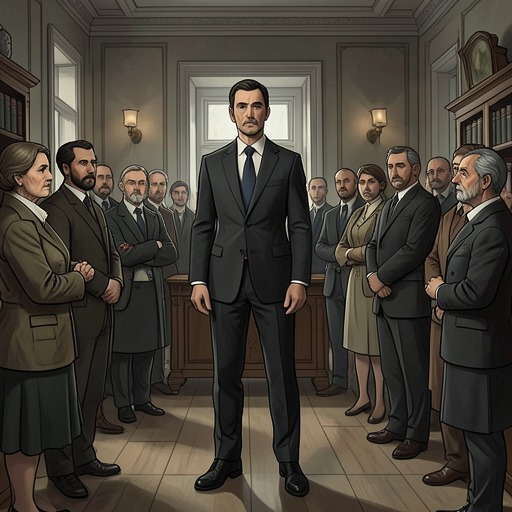
Storm Trooper studies geography at a national university. Tall, crew-cut, and high-cheekboned, he wears the same white shirt, black trousers, black shoes, and navy-blue jumper every day, adding a uniform jacket and black briefcase when he goes to university. The outfit leads other students to call him Storm Trooper, but the apparent political signal is misleading: he dresses that way because choosing clothes would be a bother, and he is indifferent to politics. His interests are literal and specialized—changes in coastlines and the completion of new railway tunnels—and once he begins talking about such subjects, he can continue until his listener escapes or falls asleep.
The mismatch between how he appears and what occupies him defines the character. Others read the uniform as an ideology; he treats it as a convenient solution to a minor daily decision. His own description of his studies, delivered with a stammer, reduces university to maps. When Watanabe cannot explain what he himself intends to do, Storm Trooper’s directness leaves him with the uncomfortable sense that his roommate’s simple reason for coming to Tokyo makes more sense than his own.
Life in the Dormitory
Storm Trooper’s room is exceptionally clean. While the other men’s rooms are marked by rubbish, stale smells, and neglected dishes, his shared room has a spotless floor and window, orderly pencil holders, and curtains washed monthly. Watanabe’s account makes clear that this is Storm Trooper’s standard, not a shared hobby: other residents do not even believe that curtains can be washed. They sympathize with Watanabe about his roommate, assuming that such obsessive order must be a burden, but Watanabe is not particularly troubled by him.
The arrangement proves useful. Storm Trooper cleans the room, airs the mattresses, disposes of rubbish, and notices when Watanabe has gone too long without bathing. He also tells him when it is time for a haircut or to trim his nasal hair. His care is practical and unsolicited, a form of attention expressed through keeping the room and its occupant in order rather than through intimacy or conversation.
That help has one disruptive edge: if Storm Trooper spots even a single fly, he sprays the room with insecticide until Watanabe has to take refuge in a neighboring room. The episode captures the peculiar scale of his habits—thoroughness that makes shared life easier in most respects can abruptly make the room uninhabitable.
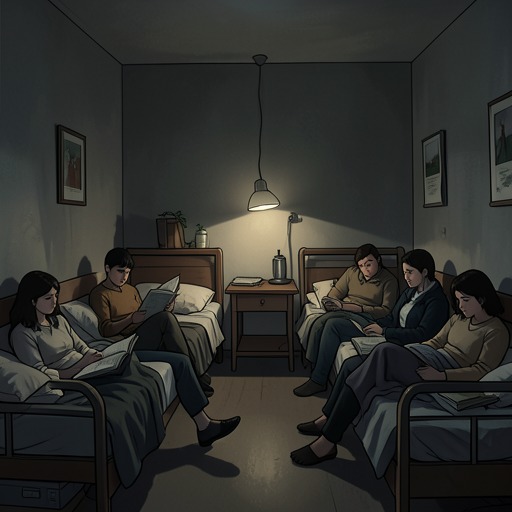
His schedule extends the same exactness beyond housekeeping. He rises at six to the dormitory’s flag-raising music, washes at length, snaps the wrinkles out of his towel, lays it on the radiator, puts away his toothbrush and soap, and joins the national radio exercises. Watanabe, who reads late and usually sleeps until eight, initially remains asleep through the routine. The jumping at the end, however, makes the bed bounce each time Storm Trooper lands. Watanabe tolerates it for three mornings in the name of communal life, then asks him on the fourth to exercise somewhere else. Storm Trooper’s astonished response—that it is already half past six—shows how completely his sense of the day differs from his roommate’s.
The Firefly and His Disappearance
Near the end of the month, Storm Trooper gives Watanabe a firefly in an instant-coffee jar, its lid pierced with air holes and the jar furnished with blades of grass and a little water. In the bright room the insect looks like an ordinary black bug, and it repeatedly tries to climb the slippery glass only to fall back. Storm Trooper insists that it is a firefly and says he found it in the quadrangle; Watanabe accepts his identification despite having no independent way to confirm it. The small gift joins Storm Trooper’s exact, material attentiveness to one of the dormitory’s few delicate living things.
Later, when university resumes in September, Storm Trooper’s absence is striking precisely because his habits have made him seem dependable and predictable. Dust gathers over his desk and radio, while his cup, toothbrush, tea tin, and insecticide remain lined up on the shelf. Watanabe keeps the room clean in his roommate’s place, sweeping daily, wiping the window every third day, and airing the mattress weekly. He imagines Storm Trooper returning and telling him what a good job he has done, but the return never comes. One day Watanabe finds the belongings gone and the name tag removed from the door. The dormitory head tells him only that Storm Trooper has withdrawn from the dormitory and that Watanabe will be alone for the time being; no reason for the departure is provided.
The lack of explanation is part of the rupture. The dormitory head, whom Watanabe regards as someone who takes pleasure in controlling information, does not tell him why Storm Trooper left. For a while an iceberg poster remains on the wall; Watanabe eventually replaces it with images of Jim Morrison and Miles Davis and buys a small stereo with money saved from work. The room becomes more his own, and he enjoys living alone, even as he thinks of Storm Trooper from time to time. The change is not presented as a simple loss: solitude gives Watanabe freedom, but that freedom begins in an absence he cannot account for.
Stories, Memory, and Narrative Role
Storm Trooper’s influence continues after his departure through anecdotes. When Watanabe visits Naoko and Reiko, he tells them about his roommate’s sudden disappearance and the last day they saw each other, when Storm Trooper gave him the firefly. Reiko wants to hear more about him; Watanabe recounts his antics, and the stories make the three of them laugh. In that moment, narration briefly restores the companionship that the room no longer holds. Watanabe later wishes Storm Trooper were still around because he could inspire a run of stories cheerful enough to lift the mood; instead, Watanabe talks about the filthy habits of the other men in the dormitory, which Naoko and Reiko find hilarious because the details are new to them.
The character also returns as a measure of Watanabe’s isolation. During the lonely April when Naoko, Midori, and Nagasawa are all absent from his immediate life, he finds himself missing even Storm Trooper. The thought emphasizes the reach of his solitude: he remembers not only the people with whom he is emotionally close, but also the roommate whose strict rules and domestic routines once filled an ordinary room. Storm Trooper’s comedy, practical care, and unexplained disappearance thus form a compact portrait of everyday connection—one that becomes visible most clearly after it is gone.